

Don't miss the new CILAC virtual event on December 9 at 5 p.m. (URU, ARG, BRA) The consumption and production modality in force today in the...
Read More

It is not a fragment of Frankenstein's monster, of Mary Shelley: Inanimate matter can be animated with a simple spray. The spray contains particles of iron, polyvinyl alcohol and gluten, which combine with water to form sticky magnetic skins or 'M-skins'.
Thanks to the magnetic properties of the aerosol, ordinary objects such as origami paper and cotton thread have been brought to life, according to A study published in Science Robotics.
The researchers captured images of the 'millirobots' rolling, swimming and walking, but they also performed tasks with a more relevant purpose: simulated biomedical procedures. Robotic catheters navigated narrow blood vessels and egg-shaped capsules delivered medications to the stomachs of live rabbits.
This is the magic of this spray, which proposes a minimalist approach to building milirobots by coating inanimate objects with a magnetic bonding compound spray. As seen in the video, the real object of this experiment is to create milirobots capable of entering the arteries or the stomach, and removing blockages thanks to movement, or releasing medications:
This approach allows covering a variety of one-dimensional objects with a thin enough film such as to preserve the original size, morphology and structure of objects while providing a performance of up to hundreds of times its own weight. Under the activation of a magnetic field, milirobots can demonstrate a variety of locomotor skills.

In addition, the magnetic film of the milirobots can be reprogrammed and disintegrated at any time. The liquid begins to disintegrate after about eight minutes in a strongly acidic environment (pH 1), but its durability lasts up to about 15 minutes if an additional layer of PVA is added. while if the iron particles are replaced with nickel particles it could remain stable for even more than half an hour..
–
The news
An aerosol has been designed that turns inanimate materials into mobile insect-scale machines
was originally published in
Xataka Science
by
Sergio Parra
.

Charles Percy Snow, in his famous conference On “The Two Cultures”, he expressed it forcefully: «What do you understand by mass, or by acceleration? It is the scientific equivalent of Can you read?
That we see in the media intellectuals who are as scientifically trained as they are in everything else may be, for the moment, an entelechy: the minimum we should demand is that intellectuals who embrace pseudoscience be portrayed as anti-intellectuals. Because they don't base their opinions on evidence, basically..
It is not about censoring ideas, or even avoiding exploring heterodox scientific ideas. The point is to consider deeply anti-scientific statements as uneducated, as the physicist emphasizes. Alan Sokal in his book Beyond intellectual frauds:
It would be better to imagine a continuum where well-established science (for example, the idea that matter is made up of atoms) is at one end; Next would be cutting-edge science (neutrino oscillations, for example) and dominant but speculative science (string theory); then, much further, bad quality science (N rays, cold fusion), and at the end, after a long journey, pseudoscience.

If you defend pseudosciences such as homeopathy, if you attack vaccines, if you suggest that 5G causes harm and a long list of ideas widely disseminated in the media, you should automatically be classified as an unread, uninformed, uneducated person, or perhaps even fanatical about some sectarian movement.
Again, it must be emphasized that these ideas can be expressed with the same joy as Miguel Bose publish your nonsense about the coronavirus on their networks. There is no need to censor. What we have to do is conveniently label, criticize, and, above all, question the media that encourages such characters and the institutions that elevate them to the category of intellectual, wise, or even political.
Yes because Among politicians we can find a certain percentage of functional illiterates. (that is, magufos) who have even directed ministries linked to science, such as Health. In the following video you can see some of the most scandalous cases. Cases that, perhaps when we consider science as an indistinguishable part of general culture, will not take place again:
–
The news
If an intellectual embraces pseudoscience or nonsense, he is not an intellectual (and even less should he be a politician).
was originally published in
Xataka Science
by
Sergio Parra
.

Two lost notebooks Charles Darwin, one of which contains the iconic 1837 sketch of the Tree of Life, have been stolen and Cambridge University Library is asking for help to locate them.
In January 2001, the notebooks disappeared. But it is now, after an exhaustive search, that it can be confirmed that they have probably not been lost, but rather stolen.
The call to find the notebooks It was released this November 24, coinciding with what is commonly known each year as 'Evolution Day', which recognizes the anniversary of Darwin's publication of The origin of species, November 24, 1859.

As explained Jessica Gardner, University Librarian and Director of Library Services:
This public appeal could be instrumental in bringing the notebooks back safely, for the benefit of all, and I would ask anyone who thinks they can help to get in touch. We would be very grateful to hear from any staff, past or present, members of the book trade, researchers or the general public, information that could assist in the recovery of the notebooks.
The image of 'Tree of Life' It is part of one of Darwin's handwritten notebooks. The notebook in question is stored in a custom-made blue box, along with a second similar notebook, where Darwin develops his theory in terms of geographical distribution, the origin of humans and classification by descent.
Darwin sketched his ideas around an evolutionary tree in the summer of 1837, having recently returned from his trip around the world aboard the HMS Beagle, more than two decades before publishing a more developed tree of life in The origin of species.
The content of the manuscript of the two notebooks, fortunately, was previously digitized, including the Tree of Life sketch, and is available at the Cambridge Digital Library.
–
The news
Charles Darwin's iconic sketch of the tree of life and help is requested to locate it
was originally published in
Xataka Science
by
Sergio Parra
.

The concept that the poor are poor because they deserve it or that they are somehow unworthy dates back to Victorian times.
However, according to this recent study on food poverty, these attitudes are still alive today, and are a very important part of How those who receive a benefit from social security are perceived.
According to the study cited, people consider or tend to consider that the poor are lazy, that they are not trying hard enough to alleviate their own difficulties, which makes them less deserving of help.
The idea of the deserving and undeserving poor is linked to our understanding of the causes of poverty: whether it is the result of “agency” or “structure.” Agency refers to the actions of an individual, while structure is the external forces that may have led to an individual's poverty.
If we are in the second case, then many people consider that the poor do not deserve help, as exemplified this tweet:

For example, if people with financial problems spent money on conspicuous or considered services, such as a streaming service or a manicure service, it was understood that they did not deserve help to feed their children. Or if they did not buy cheap and abundant food, they were considered to be somehow They did not manage their resources well and they deserved their situation. However, perhaps poor people are not so battered that they need to vent in one way or another, or have they not received enough support to manage their resources more intelligently?
It is something similar to when, in a Spanish television debate, a debater pointed out that an activist politician: "You are too fat for the hunger you are experiencing" (when in reality it is precisely the poor who are the most obese because they eat cheaper and more caloric food).
Poor people are usually born with various burdens, even at a neurochemical level, just as if they had been affected by a virus. They have less self-control, less tenacity, less intelligence, less ability to thrive, generally speaking; And furthermore, this is not so much a question of poverty itself as of inequality. So, in the debate over whether someone is responsible for their situation or not, we should at least be aware of it, as I elaborate in the following talk given at the BCNspiracy TALKS 2020:
–
The news
If it is perceived that the poor are poor because of their responsibility, we tend to believe that they do not deserve our help.
was originally published in
Xataka Science
by
Sergio Parra
.
40,000 years of changes in the ice cap in Eurasia and North America show the connection between the two extremes of the planet

The European middle class is already falling behind compared to the middle classes of emerging markets, such as China or India, and this trend, along with others, will be accelerated by the coronavirus pandemic.
As a society we must be prepared to face all these changes that are already coming, and not conceptualize them as a series of catastrophes without a solution, but as a series of opportunities to make evolutionary breakthroughs using lateral thinking. That is the main thesis of this book. Mauro F. Guillén, 2030. Traveling towards the end of the world as we know it.
Forecasting the future, there is no doubt, is an enterprise doomed to failure. But we can take into account some trends to guide us. And that is what this book aspires to be: a compass.
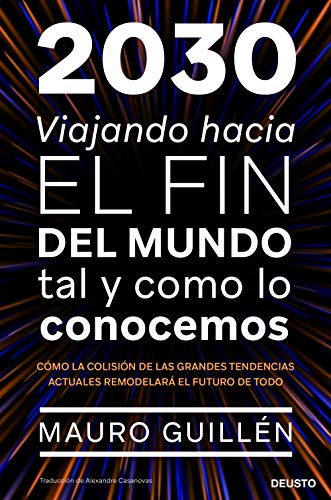
2030: Traveling to the end of the world as we know it (No collection)
Marked by economic, sociological and technological data, this compass, then, allows us two things: face the next decade with a little less fear and surprise for what is to come. And two: do it with a more resilient and constructive spirit.
For this reason, the book has also been a source of inspiration in Xataka Ciencia in order to produce entries such as The number of patents does not stop growing, but it does so especially in China either Leapfrogging: when a society makes a technological leap by skipping stages.
There was a time when the world was clearly divided between prosperous economies and backward economies. Many children were born, there were more workers than retirees and the aspirations of people who wanted to be part of the middle class consisted of having a car and a house. It was enough for companies to operate in Europe and the United States. It was paid with cash. And we expected the rules that governed our lives to be stable and predictable. But the world, pandemic through, has changed, and those rules are no longer valid.
–
The news
Books that inspire us: '2030. Traveling towards the end of the world as we know it', by Mauro F. Guillén
was originally published in
Xataka Science
by
Sergio Parra
.


