Books that inspire us: 'Curiosity: Why everything interests us' by Philip Ball

By portal-3

Libros que nos inspiran: 'Curiosidad: Por qué todo nos interesa’ de Philip Ball

Epistemic longing or, more prosaically, curiosity to know is what one of the latest books by the prolific author is about. Philip Ball. About why we are curious, about why we are interested in, potentially, everything. The title under which Ball has collected his thick essay could not be any other: Curiosity.

Episteme

In Curiosity, Ball also covers the milestones of astronomers, chemists or physicists who, in a world where curiosity was frowned upon in the wake of the original sin committed by the biblical Eve, chose to remove the shadows, ask the why of things, replace the magic and sophistry by evidence.

Curiosidad. Por qué todo nos interesa (Noema)

Curiosity. Why everything interests us (Noema)

They were heroes because some pioneers in the Middle Ages paid, sometimes with their lives, for an excess of curiosity.. For example, the story of Kepler, who by persevering revealed the structure of the movements of the planets, moving the Earth away from the center of the Universe. Or the odyssey of Galileo, who confronted the Church after seeing with his own eyes, thanks to a modest telescope, what the Moon and some planets were like.

The life of Robert Hooke will reveal to us how a person with hardly any resources can become a relevant person in science, using their innate curiosity as the only driving force.

a

Ball describes in detail the shine in the eyes of these characters, and he does it with closeness and rigor. Not in vain, Ball belongs to this lineage of men: he is a chemist and a doctor in Physics from the University of Bristol. Editor of Nature magazine, he regularly contributes to New Scientist and other scientific publications. He is also a member of the Chemistry department at University College London.


The news

Books that inspire us: 'Curiosity: Why everything interests us' by Philip Ball

was originally published in

Xataka Science

by
Sergio Parra

.

Read More

Books that inspire us: 'Anatomies' by Hugh Aldersey-Williams

By portal-3

Libros que nos inspiran: ‘Anatomías’ de Hugh Aldersey-Williams

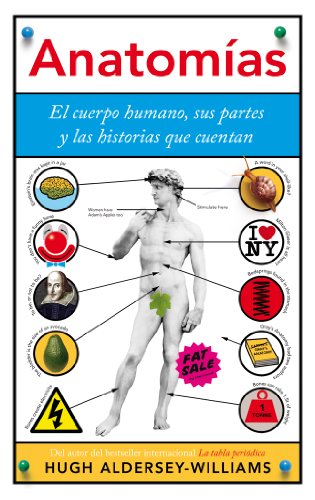
We had already been pleasantly surprised by reading The periodic table, of Hugh Aldersey-Williams, that we reviewed here a while ago, and which became one of the best chemistry popular books we had read, so now it was time to dive into another book by the same author, Anatomies, dedicated to the human body and each of its most intimate parts.

Definitely, Hugh Aldersey-Williams is one of the writers who best manages the marriage between science and literature, like a contemporary, totally alphanumeric Renaissance man.

The human body

As if he were one of the characters from the 1966 movie amazing trip, the author seems to miniaturize himself to travel inside a man's body with the purpose of revealing each of the details. Also reflecting how science has been advancing, taking possession of those newly discovered lands, dividing them into parts, proclaiming sovereignty over them in the name of new specialized disciplines.

And all of this intersected with the influence that each of those parts of the body has produced in art, literature, society, prejudices, politics, everything. Just because, The resolution of the human eye is approximately two tenths of a millimeter, which is approximately the diameter of the point that ends this sentence. But the eye was also one of the academic obsessions of the French philosopher Rene Descartes, of which we all know its Cogito ergo sum, but few know that he also wrote an essay titled The Diopter (The dioptric).

An x-ray that has been taken under the Renaissance prism on 650 muscles and 206 bones, 3 million hairs, 200,000 kilometers of veins, 440,000 million cells, a heart that beats 75 times per minute. 4,500 times per hour. 108,000 times a day. 2.8 billion times in a lifetime.

Anatomías: El cuerpo humano, sus partes y las historias que cuentan (Ariel)

Anatomies: The human body, its parts and the stories they tell (Ariel)

That's how immense, and much more, the human body is. And thanks to the compass-like pen of Aldersey-Williams, We will know how to orient ourselves better than ever in this new geography..


The news

Books that inspire us: 'Anatomies' by Hugh Aldersey-Williams

was originally published in

Xataka Science

by
Sergio Parra

.

Read More